
In this guide
What is roller-recoated metal siding? It is an insulated metal siding panel whose finished face has received a Full-Panel Roller Recoating (RC) finish after the panel was manufactured. The recoating creates a surface appearance that differs from the original coated-steel colour of the coil. Roller recoating is a finish-processing attribute: it is not a separate panel structure, and it is not a new category of building material.
This guide explains how full-panel roller recoating works, how to read the finished appearance, and how to keep the base colour, recoating colour, embossing and formed profile separate when choosing and ordering.
For importers and specifiers, separating these attributes matters because an order is confirmed by SKU: the profile, embossing, base colour and recoating colour are recorded together, and the finished appearance is judged on a physical sample rather than a single catalogue view.
Key Takeaways
- Roller recoating is applied to the face of an already manufactured panel.
- Base colour and recoating colour are separate product attributes.
- Existing embossed or formed relief contributes to the finished appearance.
- Not every pattern or profile is suitable for every recoating option.
- Buyers should confirm the selected SKU and physical sample before ordering.
What Is Full-Panel Roller Recoating?
Full-panel roller recoating is a surface treatment carried out on the finished panel face. Before recoating, the panel has already completed embossing, forming, foam-core lamination and cutting to length; the recoating then applies a colour finish to the panel face. The finished visible appearance combines several distinct attributes:
- Original coated-steel colour — the pre-coated colour of the steel coil before panel manufacture.
- Recoating colour — the finish colour applied to the finished panel through roller recoating.
- Embossing — the physical surface texture pressed into the metal face.
- Formed profile — the grooves, ribs and panel shape created during profiling.
- Final appearance — what is visible on the completed wall, combining base colour, recoat colour, relief and the light falling on it.
Conceptual relationship only; not a coating cross-section.
Roller recoating is not the same as repainting an existing building wall on site. It is a factory finish applied to a panel before installation.
A commonly seen recoating arrangement pairs a plain coil base colour with another plain face colour; this describes a common combination, not the only possible finish combination.
When looking at a recoated face, it helps to trace which parts of the appearance come from the coil base, which from the recoating finish, and which from the pressed or formed relief. The same relief can read differently under the recoat, and the same recoat colour can read differently over another base colour, which is why samples and SKU references carry the final decision.
The applied finish, existing relief and lighting contribute to the final appearance. Whether the base colour remains visible depends on the actual configuration and sample.
How Roller-Recoated Metal Siding Is Made
The sequence below shows how recoating fits into panel production. It is a conceptual overview; the production order and process conditions follow Tegravo specifications.
- Prepare the coated steel: the pre-coated coil selected for the panel base.
- Emboss and form the metal face: the surface texture and panel profile are created.
- Complete foam-core lamination and cut the panel to length: the insulated panel build-up is assembled and sized.
- Prepare the finished panel surface for recoating: the panel face is readied for the finish application.
- Apply the roller-recoated finish: the full-panel recoating colour is applied to the panel face.
- Complete the finish and inspect the panel before packing.
- Pack the finished panels: completed recoated panels are prepared for order packing.
Roller Recoating vs. Other Surface Finishes
Several surface treatments are often mentioned together, but they describe different attributes of a panel.
| Surface treatment | Main characteristics |
|---|---|
| Pre-coated steel | Colour applied to the coil before panel manufacture. |
| Printed finish | Decorative pattern printed onto the face; the pattern is part of the face artwork. |
| Transfer printing | Pattern transferred onto the face through a separate transfer process; distinct from roller recoating. |
| Film lamination | A decorative or protective film bonded onto the panel face; distinct from a roller-applied finish colour. |
| Embossing | Physical surface texture pressed into the metal. |
| Formed profile | Grooves, ribs and other panel shape created during profiling. |
| Full-panel roller recoating | Full-panel finish colour applied after the panel is manufactured. |
| Protective clear coating | Transparent protective layer; it does not introduce a new colour the way a colour-changing recoat does. |
| Spot touch-up paint | Localised touch-up applied to a small area; not a full-panel finish. |
These categories are not completely mutually exclusive: one product may combine forming, embossing and recoating attributes. Roller recoating should not be treated as a synonym for a wood-grain print, stone-grain print or brick embossing.
Where a printed pattern is fully covered by a full-panel recoat, the original print may be altered or concealed; the resulting appearance is confirmed from the physical sample.
Understanding Base Colours and Recoating Colours
Tegravo uses the following SKU structure: RC{Recoating Colour Code}-{Base Colour Code}.
| Code segment | Meaning |
|---|---|
| 7CB | Seven-Course Brick, the embossed brick profile. |
| SCB | Six-Course Brick, the embossed brick profile. |
| NFP | Formed profile code, described in customer-facing text as Broad flutes. |
| RC | Full-Panel Roller Recoating, marking that the panel carries a roller-recoated finish. |
| 306 | Recoating colour reference code. |
| 901 | Recoating colour reference code. |
| 701 | Coil base colour reference code. |
| 801 | Coil base colour reference code. |
Read the recoating colour first and the coil base colour second. A two-tone combination is not a new standalone colour code. Compare the actual SKU and physical sample before approving the finished appearance.
Embossed Brick Relief and Roller Recoating
A brick-look facade can result from several contributing features:
- Brick-course arrangement — the layout that suggests rows of brick.
- Embossed brick faces — the raised brick surfaces pressed into the metal.
- Recessed joint lines — the recessed lines that separate the brick faces.
- Base colour — the coil colour visible where it contributes to the final appearance.
- Recoating colour — the finish colour applied to the finished panel.
- Light and shadow — the way the relief reads under different viewing angles and illumination.
The brick faces and joint lines are physical surface structure. Roller recoating changes the colour appearance; it does not re-form the embossing or the formed structure, and it does not redesign the brick pattern. Whether the recoat covers raised faces, recessed lines or both, and the final texture and colour effect, are confirmed from the physical sample.
Roller-Recoated Panel Examples
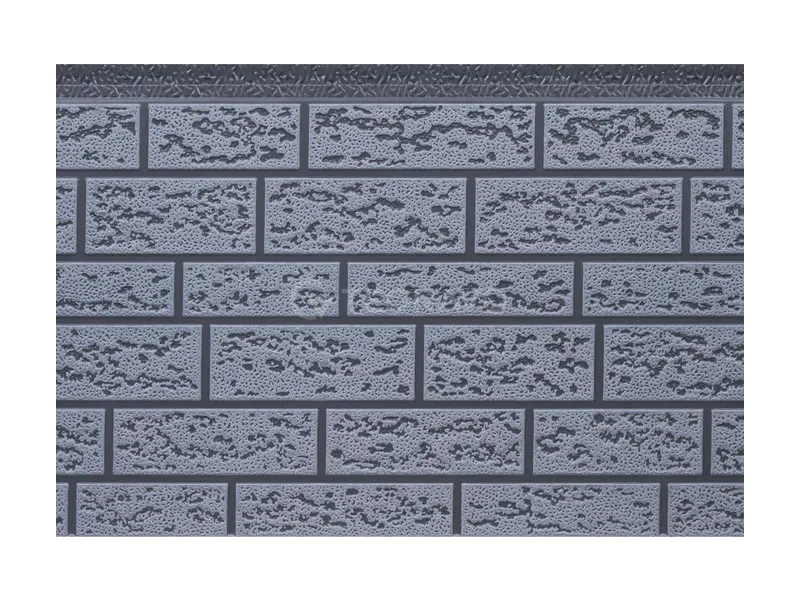
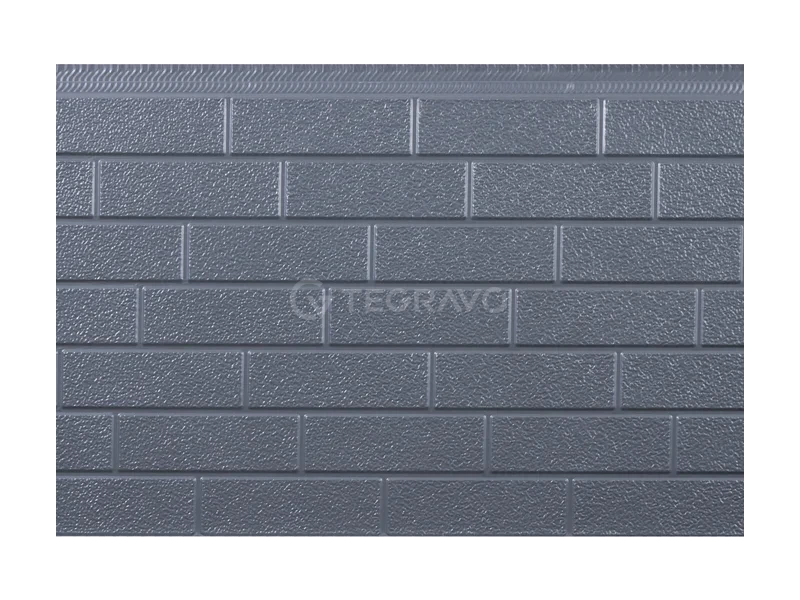
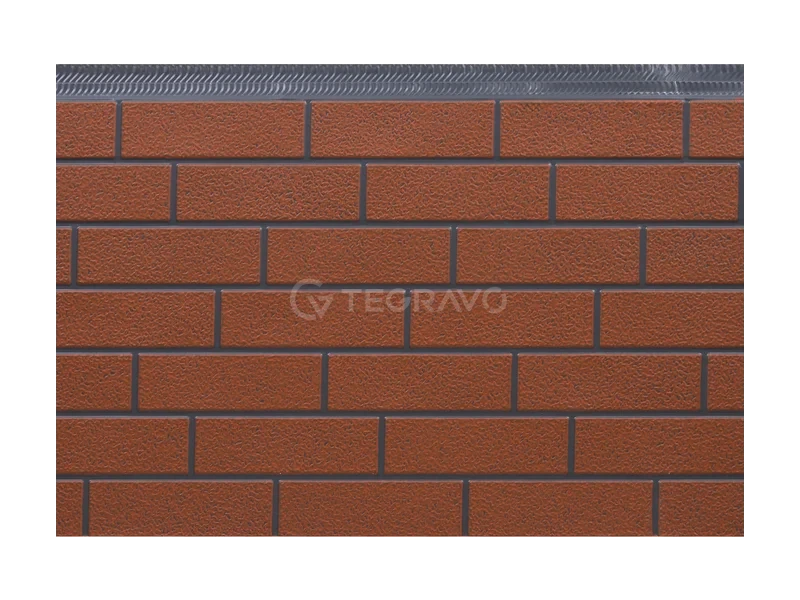
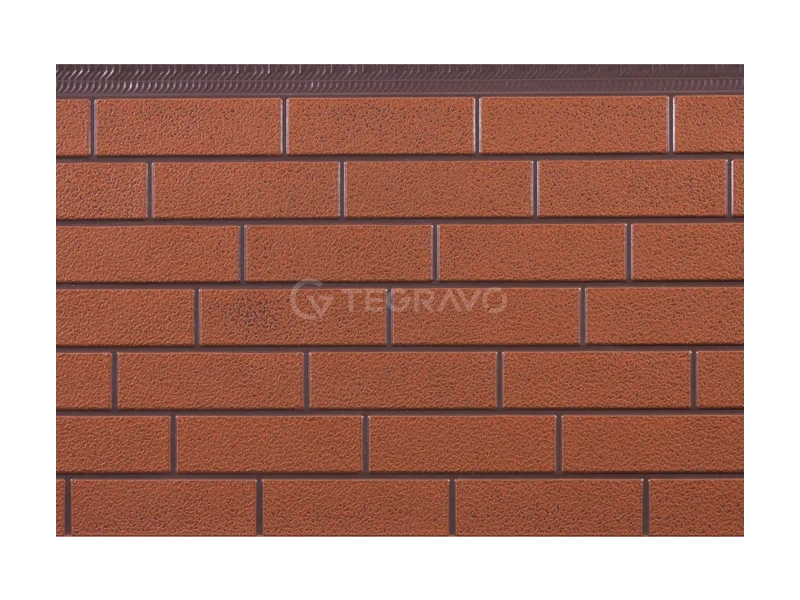
These are existing catalogue references. Availability and order details are confirmed per SKU. The photographs show separate product references; they are not matched lighting or production-batch tests.
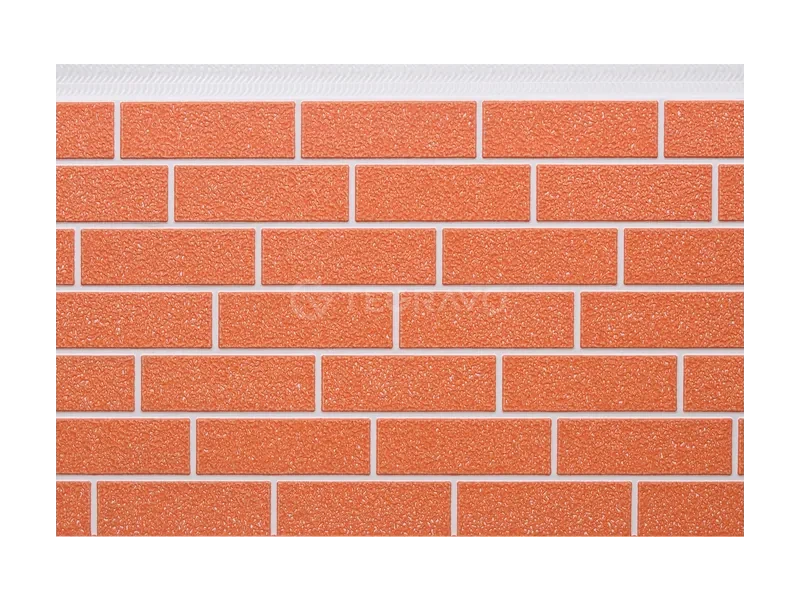
Comparison A — Same brick profile, different finish
With the same seven-course brick embossing and the same coil base reference, compare the plain finish with the roller-recoated finish.
Comparison B — Same recoating colour, different base colours
Compare the photographs to see how the same recoating colour reference can look over different coil base colours. Confirm the final appearance with a sample.
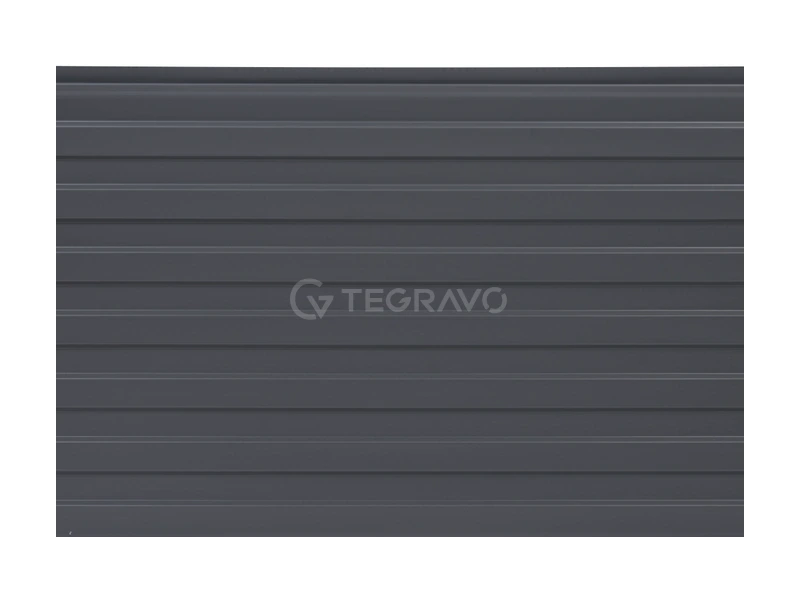
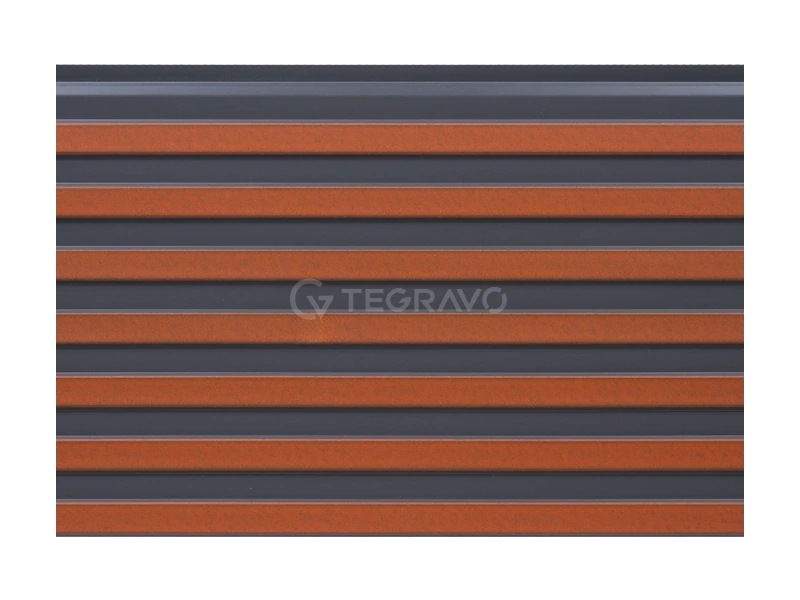
Comparison C — Same formed profile, different finish options
Explore the solid colours and textured metal siding range to compare further finish references.
The Broad flutes (NFP) formed profile shows that roller recoating can also apply to some confirmed formed-profile products; it is not limited to brick-look panels.
Architectural Applications and Design Options
Recoated appearances can be considered across a range of facade contexts:
- Residential facades.
- Prefabricated buildings.
- Modular buildings.
- Commercial facades.
- Exterior refurbishment.
- Accent walls.
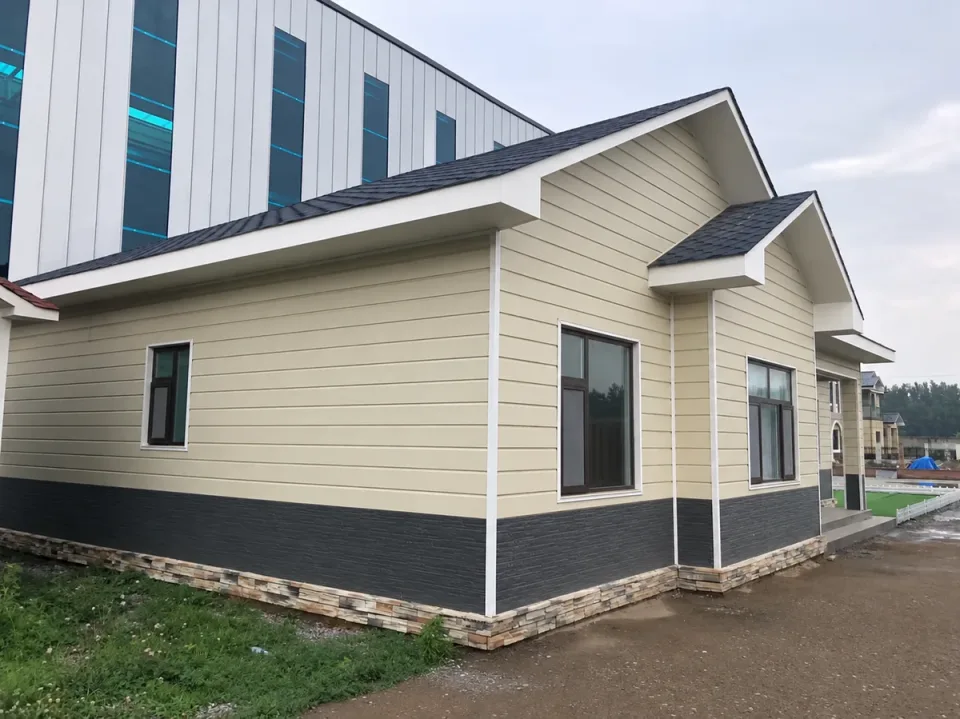
Designers can use brick-look relief, base colour, recoating colour and formed-profile differences to shape the building appearance. Accent walls and mixed finishes can pair a recoated brick-look face with plainer or formed profiles, allowing one building to combine texture and colour without relying on a single uniform finish. Any combination still depends on the profiles and recoating options confirmed in the catalogue. Explore brick-look panels and fluted panels for the available appearance families.
How to Choose a Roller-Recoated Finish
- Choose the desired architectural appearance.
- Identify the panel profile or embossing.
- Confirm the base colour.
- Confirm the recoating colour.
- Compare physical samples.
- Confirm thickness, length and accessory requirements.
The final finished colour cannot be confirmed from a screen photograph alone. Screens, camera exposure and lighting change how a finish reads. Compare physical samples under matched lighting, and record the SKU that is finally approved. For further guidance, see how to compare physical samples and choosing finishes and profiles.
What to Confirm Before Ordering
Use the following checklist when preparing an enquiry. Complete the information and send it to Tegravo so the team can confirm the finish, specification and accessory configuration.
Fill in the details locally; this checklist does not send data.
| Information needed | Detail to record |
|---|---|
| Selected SKU | |
| Panel category | |
| Formed profile | |
| Embossing | |
| Base colour code | |
| Recoating colour code | |
| Approved physical sample | |
| Panel thickness | |
| Required panel length | |
| Required cladding area | |
| Matching trim requirements | |
| Project drawings | |
| Destination country and port | |
| Required performance documentation |
Stock and custom colour acceptance are not assumed in advance. Order quantities, production scheduling, lead time and accessory configuration are confirmed against the actual order. See the thickness comparison and trims and accessories guide.
Frequently Asked Questions
What is roller-recoated metal siding?
It is an insulated metal siding panel whose manufactured face has received a full-panel roller recoating finish, creating an appearance different from the original coil colour. It is a finish attribute, not a separate panel structure.
How is roller recoating different from pre-painted steel?
Pre-painted (pre-coated) steel carries its colour on the coil before panel making. Roller recoating is applied to the finished panel after embossing, forming, lamination and cutting are complete.
Does roller recoating change the embossed texture?
Recoating changes the surface colour without re-forming the embossing or profile. The apparent texture and colour distribution, including raised faces and recessed lines, should be confirmed from a physical sample.
What is the difference between the base colour and the recoating colour?
The base colour is the original coated-steel coil colour; the recoating colour is the finish applied to the finished panel. They are separate attributes recorded as separate codes in the SKU.
Can roller recoating be applied to every metal siding panel?
Not assumed. Not every profile, colour, pattern or embossing combination has been confirmed as suitable for recoating. Check the selected SKU and combination with Tegravo.
Is roller-recoated metal siding available in 16 mm and 20 mm thicknesses?
Existing SKUs can be configured in 16 mm or 20 mm. Confirm the selected configuration with Tegravo.
Can I choose colour-matched trims for roller-recoated panels?
Colour-matched accessories are a custom option. Provide the panel SKU, colour and pattern references, trim type, quantities and drawings; matching availability is confirmed on enquiry.
Can photographs accurately represent the final recoated colour?
Not reliably on their own. Camera exposure, white balance, viewing angle, screen settings and light all affect appearance. Approve the final colour against a physical sample under matched lighting and record the approved SKU.
Conclusion
Before ordering, confirm the profile and embossing, the coil base colour, the recoating colour, the approved physical sample, and the panel specification and accessories. Roller recoating is a finish choice layered onto an already formed and embossed panel, so the final appearance should be judged on the physical sample rather than a catalogue image alone.